
Comparison
Higgs TTS vs OmniVoice (2026): Ultimate AI Voice Model Deep Comparison
By Ethan Liu, Senior Audio Tools Editor · Architecture review by Mia Chen · Updated June 22, 2026
Higgs TTS and OmniVoice keep showing up in the same AI-voice searches, but they answer different questions. One is a production SaaS platform you call through an API; the other is an open-source speech foundation model you host and customize. This deep comparison walks through where that gap actually matters — and which layer of the stack you really need in 2026.
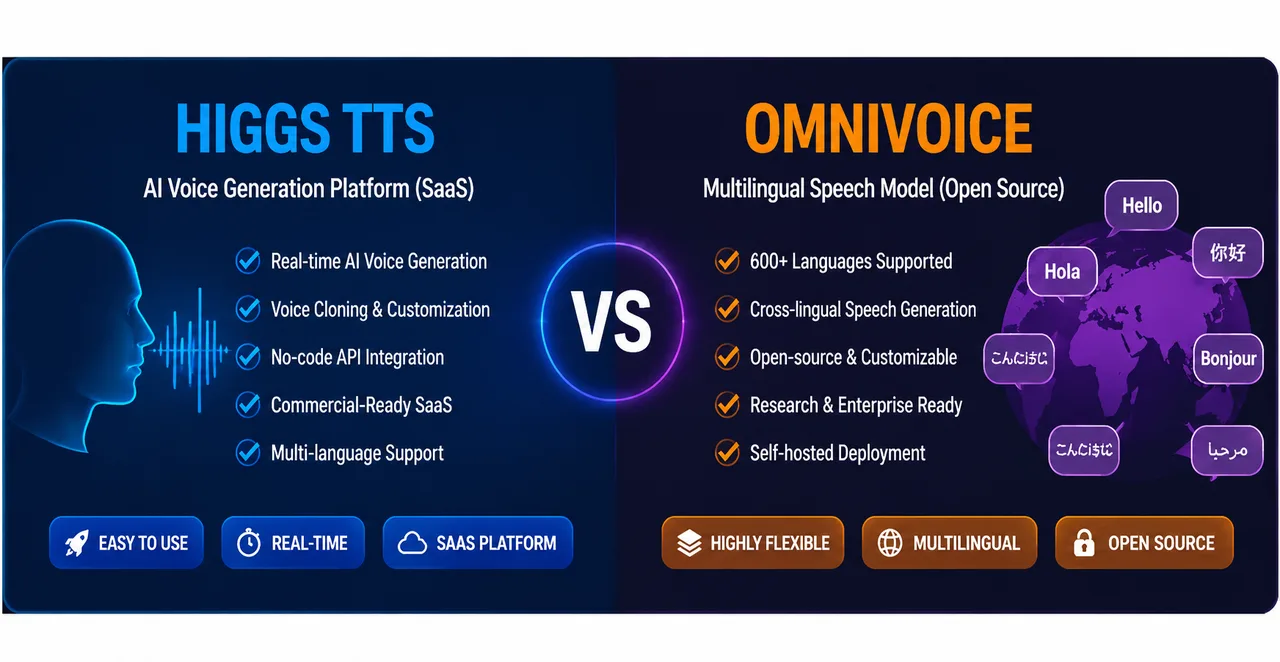
Quick verdict (read first)
If you are deciding between the two, here is the simplest breakdown: Higgs TTS is a production AI voice SaaS platform, and OmniVoice is an open speech foundation model. They are not direct competitors — they operate at different layers of the AI voice ecosystem.
Modern AI voice in 2026 spans real-time conversational systems, voice cloning platforms, multilingual models, open-source frameworks, and SaaS APIs. Within that ecosystem, Higgs TTS represents the application (product) layer, while OmniVoice represents the foundation-model layer. So the real question is not “which is better overall” — it is which layer of the AI voice stack you actually need.
What is Higgs TTS?
Higgs TTS is a production-grade AI voice SaaS platform built for real-world commercial use — not just a model, but a complete voice generation system pairing text-to-speech with voice cloning. The TTS side offers structured control: gender selection, age range, accent control (US / UK / AU / CA / IN English), speech speed, and voice styles such as a whisper mode. That makes it a parametric voice design system rather than a one-button TTS tool.
The cloning side is a structured workflow: 3–30 seconds of reference audio, an optional transcript, an explicit consent confirmation, then an asynchronous generation task whose output lands in your dashboard. Around both sits real production infrastructure — a task queue, credit-based billing, API integration, history logs, and error handling — which is what makes Higgs TTS a fit for SaaS companies and product teams rather than a research demo.
What is OmniVoice?
OmniVoice is a large-scale multilingual speech foundation model designed for research and flexible deployment — not a SaaS product. Its headline capability is breadth: support for 600+ languages, making it one of the most globally capable speech models available. It also does zero-shot voice cloning from just 3–25 seconds of audio with no retraining, and cross-lingual generation — an English reference voice can speak Chinese, an Arabic voice can speak English, with identity preserved across languages.
Crucially, OmniVoice ships as an open-source, Apache 2.0 model that you can self-host and fully customize. That is its defining strength and its defining cost: maximum control and language scale, but no built-in product, billing, or compliance layer. It is a universal speech intelligence base, not something you call and bill against on day one.
Feature-by-feature comparison
Where each system leads, based on design focus and documented capability.
| Dimension | Higgs TTS | OmniVoice | Edge |
|---|---|---|---|
| Product type | Production AI voice SaaS platform | Open-source speech foundation model | Different layers |
| Setup & deployment | Cloud API, no-code, instant | Self-hosted, GPU + engineering | Higgs TTS |
| Real-time / latency | Low-latency production pipeline | Depends on deployment hardware | Higgs TTS |
| Multilingual reach | Multilingual presets, global focus | 600+ languages, native breadth | OmniVoice |
| Cross-lingual transfer | Per-language configuration | Voice identity across languages | OmniVoice |
| Voice cloning | Structured workflow + consent step | Zero-shot, 3–25s, no retraining | Depends on use |
| Licensing & control | Managed SaaS, no infra burden | Apache 2.0, fully customizable | OmniVoice |
| Billing & monetization | Credit-based, ready-to-bill API | Indirect, build-your-own product | Higgs TTS |
| Compliance & consent | Built-in consent + usage logging | Self-managed by the developer | Higgs TTS |
The pattern down the edge column is consistent: Higgs TTS leads everywhere productization matters — setup, latency, billing, and compliance — while OmniVoice leads on raw model properties such as language scale, cross-lingual transfer, and open-source control. Voice cloning is genuinely a tie that depends on whether you value a guided, consent-gated workflow or maximum zero-shot flexibility.
Architecture comparison
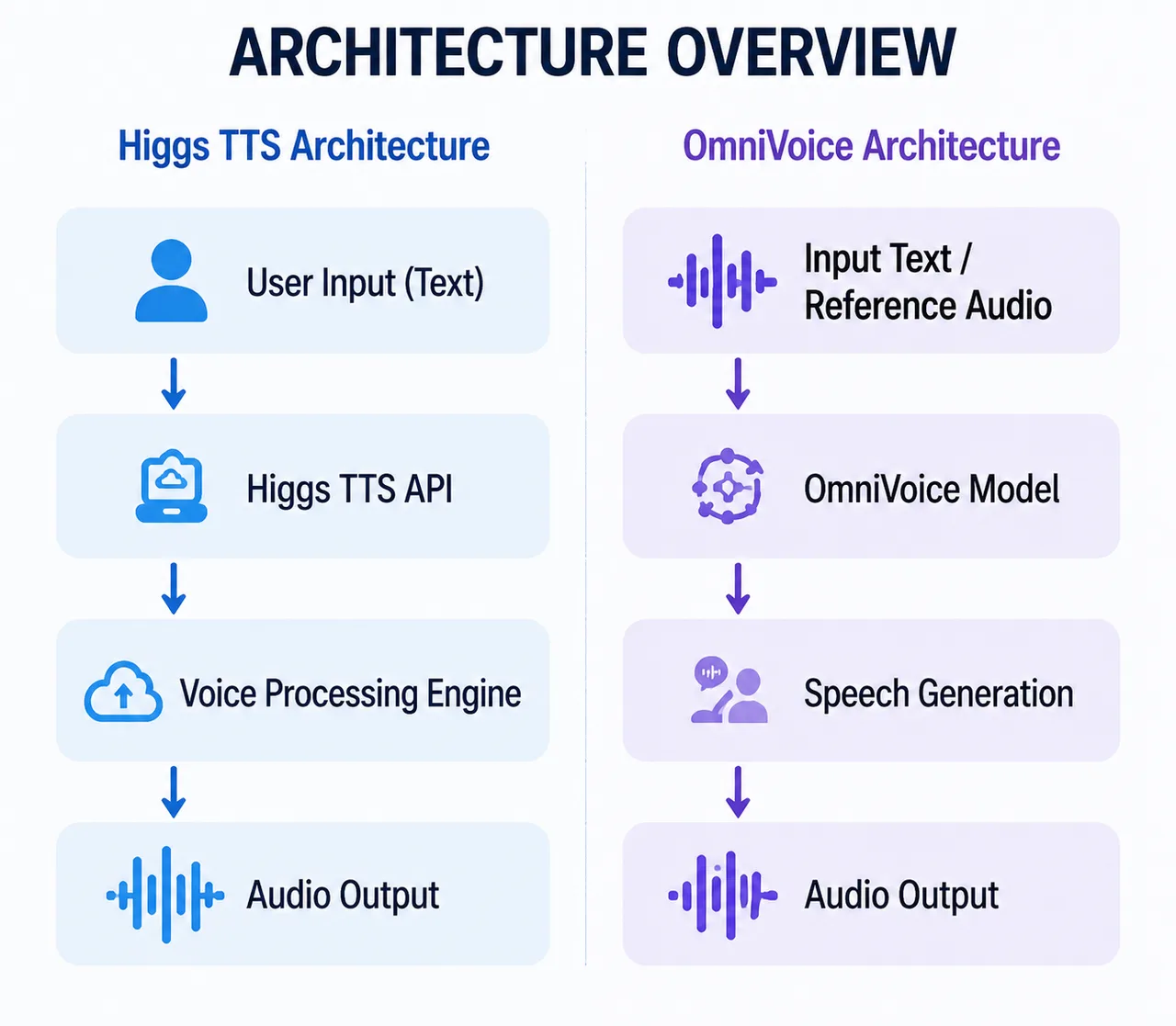
Higgs TTS is built as a full-stack voice platform across three layers. The input layer takes text plus voice-parameter controls, accent selection, and speed adjustment; the processing layer runs a task queue with credit-based, asynchronous execution; the output layer stores results in a dashboard with history tracking and API retrieval. The result is a voice production pipeline.
OmniVoice is structured as a model, not a pipeline. Tokenization turns speech into acoustic tokens with multilingual embeddings; a transformer handles sequence modeling and cross-lingual alignment; a decoding stage generates the waveform. The result is a foundation speech model — powerful raw capability that still needs a product wrapped around it.
Real-world use cases
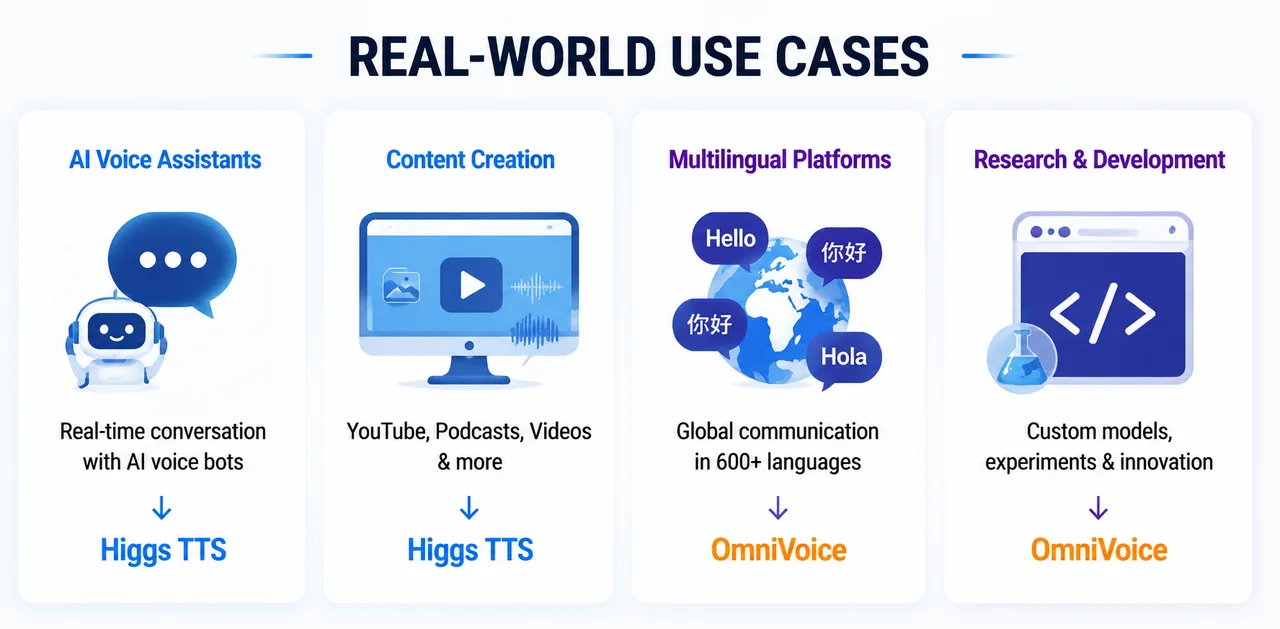
Higgs TTS is best for AI voice assistants, SaaS chatbot systems, YouTube narration, marketing voiceovers, voice API products, and customer-support automation — anywhere production-ready workflows are the priority.
OmniVoice is best for multilingual translation systems, AI research projects, open-source deployment, custom TTS pipelines, and academic experiments — anywhere flexibility and language scale outweigh turnkey convenience.
Which should you choose?
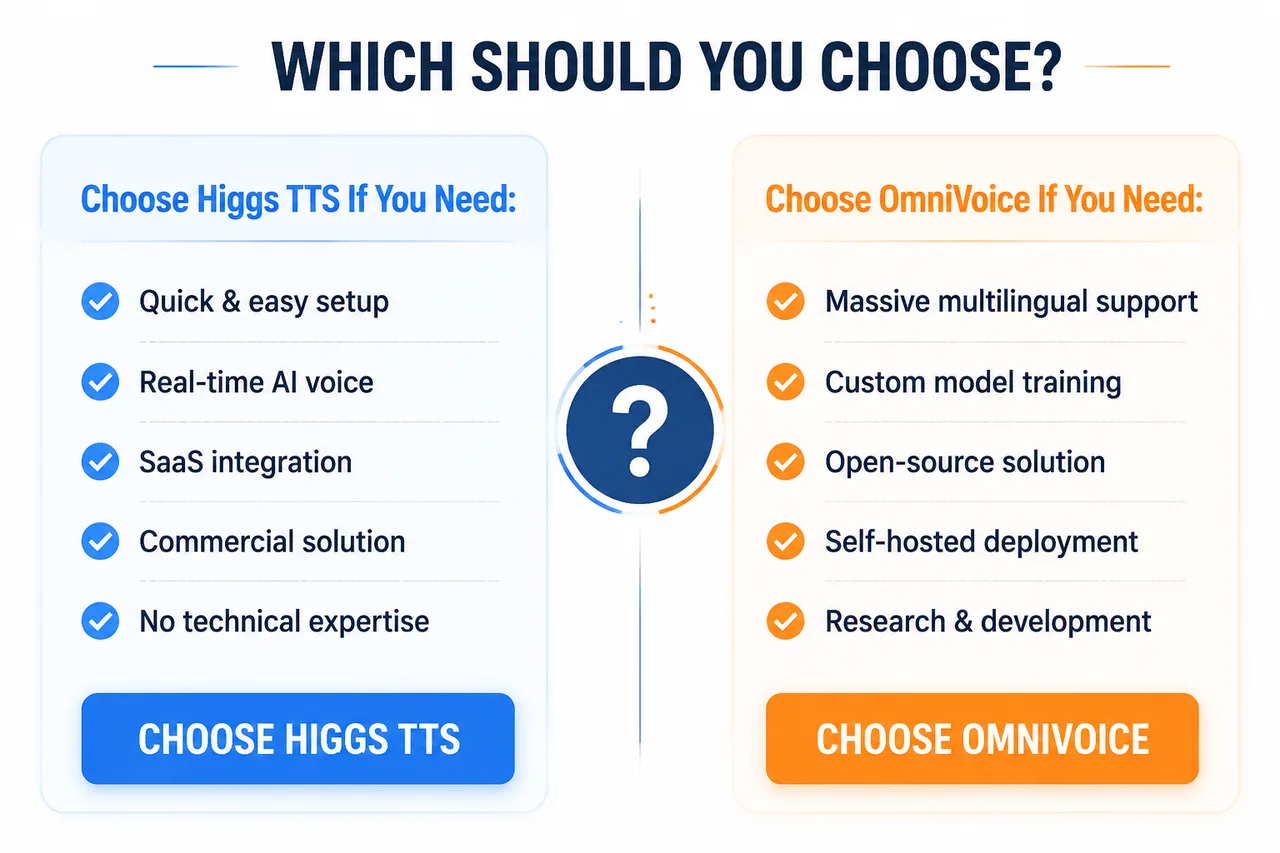
Choose Higgs TTS if you need a fast, production-ready voice system with a no-code interface, SaaS integration, commercial deployment, and a structured voice cloning workflow. It is the better fit for startups and product teams who want to ship a voice feature, not maintain infrastructure.
Choose OmniVoice if you need full model control, open-source flexibility, multilingual AI systems, research-level customization, and self-hosted infrastructure. It is the better fit for engineers and researchers who want to own and reshape the model itself.
Scenario tests
Specs only tell you so much, so we mapped both systems against three realistic scenarios and followed each one through its actual flow — input, processing, and the output you would get in production.
Test 1: Customer support AI voice bot
Input: “Hi, I want to cancel my subscription and get a refund.”
Higgs TTS: Text enters the SaaS API, a “neutral + calm support” preset is applied, and speech returns in near real time. The result is a natural service tone with stable emotional control — ready to drop straight into a live support flow.
OmniVoice: The model inference runtime loads, processes the multilingual embedding, generates the waveform, and returns output. Highly flexible, but latency depends on the deployment and it needs engineering tuning before it is conversation-ready.
Winner: Higgs TTS. Real-time business support needs predictable latency and stable tone control.
Test 2: YouTube automation voice pipeline
Input: “Today we will explain how AI is changing video editing in 2026.”
Higgs TTS: Pick a “narration voice + 1.2× speed” preset and you get a consistent, creator-ready YouTube voice with no post-processing required — it slots directly into an automated publishing workflow.
OmniVoice: Output is more flexible and better for experimental audio styles, but it expects script preprocessing, varies by model config, and needs audio normalization before it is broadcast-ready.
Winner: Higgs TTS. Automated content pipelines value consistent, ready-to-ship output over tuning.
Test 3: Multilingual translation voice system
Input: English: “Welcome to our global platform.”
Higgs TTS: Works through a limited language-preset system and needs manual configuration per language — fine for a fixed set of markets, slower when you need broad coverage.
OmniVoice: Performs direct multilingual transfer into 600+ languages and preserves the speaker’s voice identity cross-lingually — true multilingual generalization out of the box.
Winner: OmniVoice. Wide-coverage, identity-preserving translation is exactly what a foundation model is built for.
Deeper technical breakdown
The differences that decide which system survives contact with production.
Latency & real-time behavior
Higgs TTS is optimized for real-time inference with pre-configured voice pipelines and consistently low response times — the profile you want for chatbots, live assistants, and customer service. OmniVoice latency depends heavily on the deployment, model loading, and hardware, which makes it stronger for batch generation, research pipelines, and offline processing than for instant SaaS responses.
Quality control & scaling
Higgs TTS gives you structured control layers — tone, speed modulation, accent, whisper mode, age-based shaping — that produce predictable, commercial-grade output, and it scales horizontally through cloud API infrastructure, a task queue, and credit-based workload distribution. OmniVoice relies on probabilistic synthesis and multilingual embedding transfer, so quality varies by language and inference setup, and scaling is a manual, infrastructure-heavy job tied to GPU availability and engineering effort.
Compliance & developer experience
Higgs TTS bakes in voice-consent verification, structured cloning permission, and SaaS-level logging, with a no-code dashboard and API-ready endpoints — DX tuned for product teams and non-technical creators. OmniVoice puts compliance fully on the developer (usage policies, data handling, ethical safeguards) and expects Python-based integration, model loading, and manual pipeline building — DX tuned for ML engineers and research teams.
Market positioning
The two sit in different markets. Higgs TTS is a direct-to-user, productized AI voice tool that competes with SaaS voice platforms like ElevenLabs and PlayHT. OmniVoice belongs to the foundational AI-model ecosystem, competing with other open-source TTS models and academic speech systems. Higgs TTS sits closer to end users; OmniVoice sits closer to AI infrastructure — and in larger enterprise systems, the two can even be combined.
Final verdict
Higgs TTS and OmniVoice are fundamentally different things: a productized AI voice system versus a foundation speech model. Higgs TTS wins on usability, deployment, and SaaS-readiness; OmniVoice wins on language scale, research flexibility, and open-source control. For most teams shipping a real product in 2026, the application layer is the one you need first — start with Higgs Audio v3 TTS on 3 free credits, and see pricing for credit packs when you scale.
FAQ
Higgs TTS vs OmniVoice — frequently asked questions
What is the difference between Higgs TTS and OmniVoice?▼
Higgs TTS is a production AI voice SaaS product with structured TTS, voice cloning, billing and APIs. OmniVoice is a large multilingual speech foundation model meant to be self-hosted and customized. They sit at different layers of the AI voice stack.
Which is better for commercial applications?▼
Higgs TTS, because it provides structured APIs, credit-based billing, consent handling, and production workflows you can ship without building infrastructure.
Can OmniVoice replace SaaS TTS tools?▼
Not directly. OmniVoice is a foundation model — it requires self-hosting, engineering integration, and your own product layer before it behaves like a SaaS voice API.
Is Higgs TTS suitable for developers?▼
Yes. Developers integrate it through its API layer and credit system, while non-technical users can drive it from the no-code dashboard — the same product serves both.
Which is more flexible?▼
OmniVoice. Its open-source, Apache 2.0 architecture and 600+ language coverage make it the more flexible base for custom or research-grade systems.
Which is easier to use?▼
Higgs TTS. It is no-code, API-ready, and removes the infrastructure work, so most teams reach a working voice feature far faster.
Try Higgs TTS yourself
The fastest way to compare is your own script. Start with 3 free credits — no install.